Showing posts with label flat tip screwdriver. Show all posts

Thursday, October 22, 2015

How to Rewire a Table Lamp - Part 2 of 2 - Putting the Lamp Together

Fig.1 Bedroom Lamp
By Gary Boutin

Tools and Supplies:
Flat tip screwdriver
Westinghouse Lamp Kit
Glue rubber cement 

This post the eight steps on how the lamp was put together with new electrical parts.

This is the second post for the rewiring of this lamp.

Step 1: Fig.1 shows the last post "How to Rewire a Lamp - Part 1 of 2 - Taking Apart the Lamp!" the porcelain lamp completely devoid of electrical wiring.  
Step 2: Fig.2 shows the old twisted wire still in the lamp. Fig.3 shows a string attached to the old wire so the string will be pulled into the lamp. Fig.4 shows that the string needs to be pulled to get the old wire out and the new wire into the lamp.

Fig.2 Old twisted wire
Fig.3 Attached string to old wire
Fig.4 Pull the string
Step 3: Fig.5 shows the schematic diagram of the new lamp rewiring. The difference is that this schematic shows the lamp electrical cord coming out of the lamp socket while this lamp was wired through the lamp. 
Step 5: Schematic diagram
Step 4: Fig.6 shows the lamp rod has the cork washer and the white nut that will be placed on the lamp above the cork washer. Fig.7 shows the arrangement of the lock washer and the bottom of the harp being placed in sequenced so the lamp is secured. Fig.8 shows the threaded socket cap at the base of the lamp rod.
Fig.6 Cork nut
Fig.7 White nut
Fig.8 Threaded socket cap


Step 5: Fig.9 shows the wire knot being tied before the wires are attached to the socket. Fig.10 shows that a screwdriver was used to tightened both electrical wire ends to the socket terminal screws.
Fig.9 Start wire knot
Fig.10 Wire knot
Step 6: Fig.11 shows the electrical socket is seated inside the socket cap. Fig.12 shows the lamp was flipped upside down and rubber cement was used to glue the cardboard felt underneath the lamp.
Fig.11 Electrical socket ready

Fig.12 Cement felt on lamp
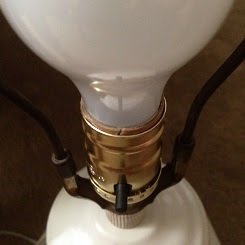
Step 7: Fig.13 shows a bulb and the lamp harp was placed inside the lamp. Fig.14 shows the electrical socket is working correctly and the lamp is on.

Fig.13 Bulb inserted
Fig.14 Lamp harp inserted
Step 8: Fig.15 shows the lamp finial is placed on the lamp shade. Fig.16 shows the lamp back into my bedroom and now in use.
Fig.15 Finial
Fig.16 Bedroom Lamp
How to a Rewire a Lamp:

Update: DIY Advisor has New blogs check them today:

  • Cookie Alert: European Union laws requires that you know that this blog uses cookies. If you are concerned about this please click here to see how Google uses this information.

Note: The DIY Advisor assumes no liability for omissions, errors or the outcome of any jobs. The reader must always exercise reasonable caution, follow current codes and regulations that may apply, and is urged to consult with a licensed contractor if in doubt about any steps on these posts. All names were changed to protect client's privacy. DIY Advisor. Reproduction of site content including photos without permission prohibited. All rights reserved. © Copyright 2011-

Saturday, March 8, 2014

How to Remove a Leaking Sink Basket - Part 2 of 2 - Installing the Sink Basket

Fig.1 shows the new stainless 
steel sink basket kit
By Gary Boutin
   
Parts and Supplies:  
Crescent wrench 
EZ-Lock Sink Strainer Kit
Flat tip screwdriver 
Sink Wrench

Mrs Stone wanted her kitchen sink to stop leaking and my repair service was hired to solve her problem. 

This post shows five steps to install the new sink basket underneath the sink. 

Step 1: Fig.1 shows the new EZ-Lock Sink Strainer and sink basket kit.
Step 2: Fig.2 and fig.3 shows pictographs instructions on how to install the sink basket.
Fig.2 Installation instructions
Fig.3 Instructions
Step 3: Fig.4 shows what the parts look like removed from the box.
Fig.4 Sink basket parts
Step 4: Fig.5 shows the sink basket that will be secured underneath the sink.
Fig.5 Parts that secure the sink basket
Step 5: Fig.6 shows bottom view of the sink basket now installed except for the drain pipes.
The pipes were re-attached and the sink now works correctly without leaking. Job finished.
Fig.6 Bottom view of sink basket

How to Remove a Leaking Basket:
  • Part 1 of 2 - Removal
  • Part 2 of 2 - Installing the Sink Basket

Update: DIY Advisor has New blogs check them today:

  • Cookie Alert: European Union laws requires that you know that this blog uses cookies. If you are concerned about this please click here to see how Google uses this information.

Note: The DIY Advisor assumes no liability for omissions, errors or the outcome of any jobs. The reader must always exercise reasonable caution, follow current codes and regulations that may apply, and is urged to consult with a licensed contractor if in doubt about any steps on these posts. All names were changed to protect client's privacy. DIY Advisor. Reproduction of site content including photos without permission prohibited. All rights reserved. © Copyright 2011-

Saturday, August 24, 2013

How to Repair a Door Handle

Flat tipped screwdriver
By Gary Boutin

Supplies:
#8 brass 3/4-inch door screws
Cordless screwdriver with Phillips tip
Door handle cover

Dr. Shaw tried to replace his door handle on the garage door. He was so frustrated with the knob that it was a little bent when we arrived. He called my repair service to fix his door handle. Carl, my friend, helped solve this door knob issue.

This post shows the five steps to replace the inside door handle.

Step 1: Fig.1 shows the handle. We were not able to use this part and this went to the recycle metal yard.
Fig.1 Damaged door handle
Step 2: Fig.2 shows a door handle not the one we used, but after sorting through all the doctor's old door parts, we found a gold inside door knob that worked on the door.
Fig.2 Door knob extra part
Step 3: Fig.3 shows Carl, who is helping me work on this door knob change.

Fig.3 Carl fixing the door knob
Step 4: Fig.4 shows the dead latch and fig.5 shows a door knob base that is the backbone of the door knob. Sometimes the parts are not interchangeable, but this time we were lucky. All that needed to be changed was the inside door knob. But it's important to make sure that the parts work before placing them on the door. It would have been easier to just purchase a new door lock set.
Fig.4 Dead latch
Fig.5 Door knob base

Step 5: Fig.6 shows an old door knob on the left. On the right shows a used gold door knob on the inside of the metal door. We were able to use the old dead latch; we just replaced the wood screws.
Fig.6 Shows the old and used gold door knobs
Step 6: Fig.7 shows a close up of the gold door knob in the unlocked position. It's great if you can use several older locks to work, but they also have to be able to lock on the inside of the door. Our key worked perfectly to lock and to unlock the door, the next step was to check that the inside door lock assembly would lock. We were lucky and it did lock just fine, saving Dr. Shaw additional funds.

Fig.7 Door knob unlocked
Step 7: Fig.8 shows the door knob would lock from the inside. This job is finished and now Dr. Shaw can lock his garage side door again.
Fig.8 Door knob locked
Update: DIY Advisor has New blogs check them today:

  • Cookie Alert: European Union laws requires that you know that this blog uses cookies. If you are concerned about this please click here to see how Google uses this information.

Note: The DIY Advisor assumes no liability for omissions, errors or the outcome of any jobs. The reader must always exercise reasonable caution, follow current codes and regulations that may apply, and is urged to consult with a licensed contractor if in doubt about any steps on these posts. All names were changed to protect client's privacy. DIY Advisor. Reproduction of site content including photos without permission prohibited. All rights reserved. © Copyright 2011-

Thursday, March 21, 2013

How to Replace A/C Paper Filter to NaturalAire® Fiberglass Filter

Fig.1 AC
By Gary Boutin

Supplies and Tools:
20X20X1 A/C Paper filter
18X30X1 A/C Paper filter 
A/C Permanent filter - NaturalAire®
Flat tip screwdriver
Scissors 

Mrs. Kwaski wanted her home filters replaced, the air coming out of the registers smelled dusty. 

This post shows five steps on how to save money purchasing A/C filters. 

Step 1: Fig.1 shows the A/C registry located on the ceiling. This one was on two ceiling in different part of the house.
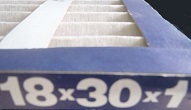
Step 2: Remove the fig.2 shows the 20X20X1 and fig.3 shows the 18X30X1 A/C dirty paper filter.
Fig.1 20x20x1
Fig.2 18x30x1
Step 3: Purchase the recycle filter named NaturalAire. It comes in size 24 in. x 36 in. x 1 in. Cut-To-Fit.
Fig.3 Natural fibers
Fig.4 Cut to fit
Step 4: Fig.5 shows strong scissors that will be used to cut the fiberglass filter. Fig.6 shows the paper filter on top of the fiberglass filter and preparations to get the best fit.
Step 5: Now replace the fabric filter into the A/C registry. The new filter will be pliable and not like the paper filter with a cardboard exterior. This pliable filter can be cleaned with water and be used over again. While the paper filter can only be used once. Some Air Conditioners companies state in their information that state that these filter may void your warranty.
Fig.5 Scissors
Fig.6 Fiberglass filter
 
Update: DIY Advisor has New blogs check them today:

  • Cookie Alert: European Union laws requires that you know that this blog uses cookies. If you are concerned about this please click here to see how Google uses this information.

Note: The DIY Advisor assumes no liability for omissions, errors or the outcome of any jobs. The reader must always exercise reasonable caution, follow current codes and regulations that may apply, and is urged to consult with a licensed contractor if in doubt about any steps on these posts. All names were changed to protect client's privacy. DIY Advisor. Reproduction of site content including photos without permission prohibited. All rights reserved. © Copyright 2011-