Showing posts with label wall tape. Show all posts

Saturday, April 9, 2016

How to Repair Dining Room Ceiling Leak - Part 1 of 2 - Ceiling Repair

Fig.1 Wet ceiling 
from leaking copper pipe
By Gary Boutin

Supplies and Tools:
500-watt lamps (3)
Drywall 36 inch by 36 inch
Drywall knives
Drywall sander (manual)
Drywall saw 
Drywall screws coarse 1-1/4 inch
Gloves (protect hands)
Joint Compound Fast set 20 minutes
Ladder 6 feet
Sanding screens
Wall tape (paper)

Mr. Johnson lives in Norco, California. He had called a plumber to repair a leaking copper pipe. The damaged pipe had been leaking for a long time and the entire ceiling was wet and soggy. The local plumber punctured the ceiling just enough to repair the copper pipe and the ABS sewage pipe. Two pipes were leaking, the copper pressure tee pipe, and an ABS drain pipe. The copper pressure tee pipe was replaced and soldered. The ABS pipe was not glued in place and was loose at the union. The plumber managed to pull it apart and insert ABS cement inside the pipe. This pipe was not under pressure like the copper pipe so repairs were easier. Mr. Johnson called my repair service to repair and paint his dining room ceiling. The catch was the job had to be done in one day because the family was leaving to New Mexico the next day.

This post shows the nine steps to quickly repair the dining room ceiling.   

Step 1: Fig.1 shows a little hole in the dining ceiling were the plumber did all of his repairs.  
Step 2: Fig.2 shows a close up of the copper tee that was repaired. Fig.3 through fig.6 shows the wood studs that will be used to pull up the ceiling. 
Fig.2 Copper tee
Fig.3 Wood studs
Fig.4 Another ceiling view

Fig.5  Cutting the corner
Fig.6 Ceiling is apart
from  the wood stud

Step 3: Fig.7 and fig.8 shows the tools for this job. Fig.7 shows painter's tarp placed on the floor to cover the dining room tile. Fig.8 shows a joint compound, yellow mud pan, drywall knives and sanding screens required for this job. 

Note: To make the joint compound dry faster use Westpac Fast Set 20 Lite Setting joint compound. This compound dries hard in 20 minutes.
Fig.7 Tarp the floor
Fig.8 Joint compound, 
texture and tools
Step 4: Fig.9 and fig.10 shows the drywall saw cutting the hole into a square and near wood studs. The studs are important because the ceiling is so wet that it needed to dry out. Placing drywall screws with flat washers will pull up the wet ceiling. Later the washer were removed and new drywall screws were inserted. Luckily this would dry as the new drywall was replaced. Fig.11 shows the new drywall piece cut at 36 inches was easier to put into the ceiling then cutting several pieces of wallboard.
Fig.9 Cuting the 
ceiling square
Fig.10 Cut the black line
Fig.11 New wallboard 
secured to ceiling
Note: While the ceiling area was cut, three 500-watt lamps were placed on the floor to help dry the  ceiling. 

Step 5: Fig.11 shows the wallboard (drywall) has been placed into the ceiling area. Many 1-1/4 inch coarse drywall screws were used to secure the wet drywall to the ceiling studs.
Step 6: Fig.12 and fig.13 the wall has been patched and now is drying. 
Note: Using three 500-watts lamp baked the ceiling patch. 
Fig.12 Wall tape was 
used on all edges
Fig.13 Patch is drying
 now needs sanding
Step 7: Fig.14 and fig.15 shows the addition of joint compound. Now make the ceiling as flat as possible. The last coat was a very light coat to finish the ceiling.
Fig.14 Load up the ceiling
Fig.15 Flatten the joint 
compound using a wall knife
Step 8: Fig.16 shows the ceiling is drying the outer edges are dry and the center part of the patch is still wet.
Fig.16 Patch is drying
Step 9: Fig.17 shows that gloves must be worn when sanding joint compound. Fig.18 shows a hand sander with a sanding screen. Fig.19 shows a drywall (Hook and Loop) pole sander with 120 grit sanding screen aids in making the ceiling flat.
Fig.17 Wear gloves 
lime irritates the skin
Fig.18 Hand sander
Fig.19 Pole Sander


How To Repair a Dining Room Ceiling Leak:

Update: DIY Advisor has New blogs check them today:

  • Cookie Alert: European Union laws requires that you know that this blog uses cookies. If you are concerned about this please click here to see how Google uses this information.

Note: The DIY Advisor assumes no liability for omissions, errors or the outcome of any jobs. The reader must always exercise reasonable caution, follow current codes and regulations that may apply, and is urged to consult with a licensed contractor if in doubt about any steps on these posts. All names were changed to protect client's privacy. DIY Advisor. Reproduction of site content including photos without permission prohibited. All rights reserved. © Copyright 2011-

Monday, April 6, 2015

How to Install Kitchen Nook Wall - Part 4 of 5 - Install New Sheetrock

By Gary Boutin
Fig.1 Dining room walls damages  
Left, middle and right wall repair


Supplies and Tools: 
500 watt Heat lamp
Drywall knife
Cordless screwdriver with many tips
Razor knife and extra blades
Scraper (2 in. 3 in. and 5 in. wall knife)

Screwdriver Phillip bit
Sponge large yellow
Tarps cotton 9 ft. x 12 ft.
Trash  bag or trash can
Tool bag
Vacuum Cleaner
Vice Grip
Wall tape (paper)

Wall saw - rubber handle

A client in Santa Clarita, California was selling their home and moving to Colorado. Their Realtor checked the kitchen nook and noticed that the dining room wallpaper was loose. She also noticed that the kitchen windows had bad rubber seals and leaked when the backyard sprinklers were sprayed on the glass windows. This needed to be repaired immediately. 

This post shows the eight steps showing the damages to this kitchen nook wall. 

Step 1: Fig.1 shows the kitchen nook wall that needs repair, left, middle and right walls.
Step 2: Fig.2 shows the drywall knife that will be used to cut the new wall. Fig.3 shows the the new drywall is in place.
Fig.2 Drywall knife
Fig.3 Replacing new sheet rock
Step 3: Fig.4 and fig.5 shows the progression of how to place drywall was placed around a duplex electrical plug.
Fig.4 No wall
Fig.5 Cut hole
Step 4: Fig.6 and fig.7 shows the joint compound being placed on the wall and over the paper tape.
Fig.6 Joint compound
Fig.7 Drywall knife
Step 5: Fig.8 and fig.9 shows the joint compound drying over the paper tape.
Fig.8 Paper tape
Fig.9 Corner
Step 6: Fig.10 and fig.11 shows the wall being sanded by the electrical plug and also the corner area.
Fig.10 Sand plug
Fig.11 Sand corner
Step 7: Fig.12 shows the drywall lime that will need to be vacuumed before painting.
Fig.12 Drywall lime
Step 8: Fig.13 and fig.14 shows the two 500-watt lamps drying the wall for priming and applying the wallpaper. Click the 500-Watt lamp to see how to change the Halogen bulb.
Fig.13 Drying the entire wall
Fig.14 Drying right side


How To Repair a Kitchen Nook Wall:


Update: DIY Advisor has New blogs check them today:
  • Cookie Alert: European Union laws requires that you know that this blog uses cookies. If you are concerned about this please click here to see how Google uses this information.


Note: The DIY Advisor assumes no liability for omissions, errors or the outcome of any jobs. The reader must always exercise reasonable caution, follow current codes and regulations that may apply, and is urged to consult with a licensed contractor if in doubt about any steps on these posts. All names were changed to protect client's privacy. DIY Advisor. Reproduction of site content including photos without permission prohibited. All rights reserved. © Copyright 2011-2016

How to Install Kitchen Nook Wall - Part 3 of 5 - Remove Wet Wall

Fig.1 Dining room walls damages
Left, middle and right wall repair
By Gary Boutin

Supplies and Tools: 
500 watt Heat lamp
Caulking white
Cordless screwdriver with many tips
Razor knife and extra blades
Scraper (2 in. 3 in. and 5 in. wall knife)
Screwdriver Flat (regular and small)
Screwdriver Phillip
Fig.2 Drywall knife
Sponge large yellow
Tarps cotton 9 ft. x 12 ft.
Trash  bag or trash can
Tool bag
Vacuum Cleaner 
Vice Grip 
Wall tape (paper)

A client in Santa Clarita, California was selling their home and moving to Colorado. Their realtor checked the kitchen nook and noticed that the dining room wallpaper was loose. She also noticed that the kitchen windows had bad rubber seals and leaked when the backyard sprinklers were sprayed on the glass windows. This needed to be repaired immediately. 

This post shows the seven steps showing the damages to this kitchen nook wall.

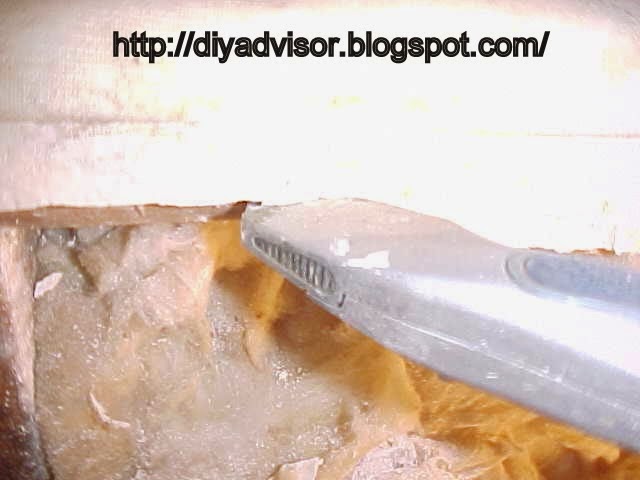
Step 1: Fig.1 shows the kitchen nook wall that needs repair and fig.2 shows a drywall knife used to cut up the wall so it can be square for repairs.
Step 2: Fig.3 through fig.5 shows the removal of the electrical plug that was in the center damaged wall. All the fiberglass was wet and needed to dry out before the new wall panels were replaced. Fig.4 shows that a small flat tipped screwdriver was used to remove the two outlet screws.  Fig.5 shows the outlet completely out of the electrical box.
Fig.3 Wet electrical
Fig.4 Remove outlet screws
Fig.5 Pullout duplex plug
Step 3: Fig.6 shows the use of razor knife to keep the edge straight to make it easier to install the new wallboard.
Fig.6 Cut edges square
Step 4: Fig.7 shows that part of the wall was removed to half of the wood stud. This will give the new piece some support. Fig.8 shows that the middle wall on the left side was completely removed and was not repairable.
Fig.7 Cut to stud
Fig.8 Wallboard removed
Step 5: Fig.9 shows that the more the wall was looked at more of the wall was removed. Almost half the wall was so wet that it was removed and not repairable. Even the fiberglass was damaged from the leak, notice that the right side is a different color than the left side. The water damage was worst on the left side than the right side.
Fig.9 Wallboard removed
Step 6: Fig.10 and fig.11 shows that a use of the vacuum cleaner was used to remove all the loose debris (pieces) that was left inside and outside the wall. Bigger portion of the wall was placed into a trash can. The wallpaper was stripped from the wall and saved for later application.
Fig.10 Cleaning the studs
Fig.11 Vacuuming inside the wall
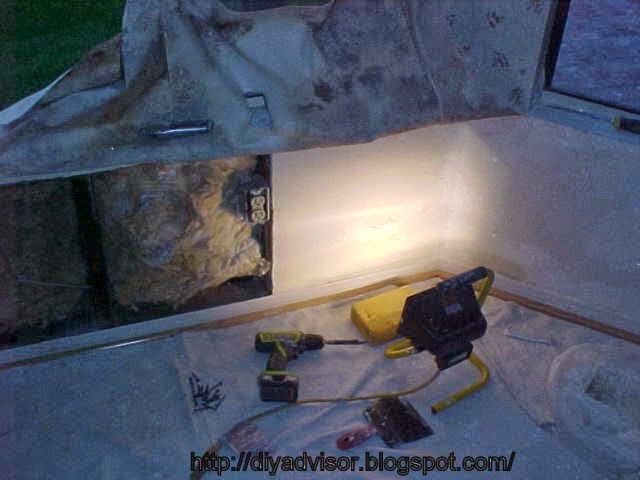
Step 7: Fig.12 shows the right part of the wall was repaired at the bottom and not entirely replaced. A 500 watt heat lamp was used to dry the insulation and the wall repair. Noticed all the wallpaper was moved upwards away from the repair. Now the wall is ready for its new skin.
Fig.12 Drying insulation

How To Repair a Kitchen Nook Wall:


Update: DIY Advisor has New blogs check them today:
  • Cookie Alert: European Union laws requires that you know that this blog uses cookies. If you are concerned about this please click here to see how Google uses this information.


Note: The DIY Advisor assumes no liability for omissions, errors or the outcome of any jobs. The reader must always exercise reasonable caution, follow current codes and regulations that may apply, and is urged to consult with a licensed contractor if in doubt about any steps on these posts. All names were changed to protect client's privacy. DIY Advisor. Reproduction of site content including photos without permission prohibited. All rights reserved. © Copyright 2011-


Tuesday, May 7, 2013

How to Hang Pre-hung Door - Part 10 of 15 - Inside Door Mud

Fig.1 Joint compound
By Gary Boutin

Supplies and Tools:
Cordless screwdriver with Phillip bit
Mud knives
Mud also called joint compound
Wall tape

Mr. Victor Longpont hired my services to remove his garage door that had become damaged after a bad rain storm. The door had not been painted for over 30 years, the bottom of the door was damaged by a badly worn door sweep that allowed water into the bottom of the door. 

This post shows the six steps to applying joint compound inside the door jamb. 

Step 1: Fig.1 shows that the joint compound was removed from a new container and applied to the open gaps in the doorway.  
Step 2: Fig.2 shows the a mud knife was used to apply the mud and make an edge for the corner bead.
Fig.2 Tape and joint compound
Step 3: Fig.3 shows the application of mud all around the door and flatten the mud as much as possible.  
Fig.3 Taping top
Step 4: Fig.4 shows a gap between the door jamb and the sheetrock. This side is not as bad as the hinge side.
Fig.4 Taping 
around lock plate
Step 5: Fig.5 and fig.6 shows that mud was applied on the top right of the door. Fig.6 shows a larger perspective of the work done inside the door jamb.
Fig.5 Taping 
around door edges
Fig.6 Above electrical alarm
Step 6: Fig.7 shows the door jamb is smooth all ready to apply the corner bead to the door jamb edges and fig.8 shows that this part of the job is finished.
Fig.7
Fig.8 Tape 
behind door hinges

How to Hang a Pre-hung Door:


  • Part 1 of 15 Introduction Why Replace This Garage Door
  • Part 2 of 15 Removing The Damaged Door
  • Part 3 of 15 Door Hardware Removed
  • Part 4 of 15 Door Threshold Removal
  • Part 5 of 15 Installing Door
  • Part 6 of 15 Recycled Metal Removed
  • Part 7 of 15 Caulking Outside Door Edges
  • Part 8 of 15 New Door Hardware Installed
  • Part 9 of 15 Caulking Door Screws Holes
  • Part 10 of 15 Inside Door Mud
  • Part 11 of 15 Inside Door Taping
  • Part 12 of 15 Inside Door Painted
  • Part 13 of 15 Applying Stucco To Door Edge
  • Part 14 of 15 Exterior Door Molding
  • Part 15 of 15 Old Door Cut to Trash


  • Update: DIY Advisor has New blogs check them today:

    • Cookie Alert: European Union laws requires that you know that this blog uses cookies. If you are concerned about this please click here to see how Google uses this information.

    Note: The DIY Advisor assumes no liability for omissions, errors or the outcome of any jobs. The reader must always exercise reasonable caution, follow current codes and regulations that may apply, and is urged to consult with a licensed contractor if in doubt about any steps on these posts. All names were changed to protect client's privacy. DIY Advisor. Reproduction of site content including photos without permission prohibited. All rights reserved. © Copyright 2011-