Friday, October 23, 2015

How to Repair Soap Damaged Shelf - Part 1 of 6 - Remove Soap

Fig.1 Laundry
By Gary Boutin

Tools and Supplies:
Dry clean towel

We have lived in our condominium for seven years and the laundry shelf  was damaged from the liquid soap we used in our washing machine. This is a simple repair and these next six post shows how this shelf was repaired.

This post shows the first step in repairing this laundry soap shelf.

Step 1: Fig.1 shows the laundry door to our laundry room. Fig.2 shows that the first step is to remove the soaps from this shelf.
Fig.2 The soap


Step 2: Fig.3 shows the soap damage to the shelf.
Fig.3 The damage

Step 3: Fig.4 shows that a clean towel moistened with water was used to remove the soap from the shelf.
Fig.4 Use water
Step 4: Fig.5 shows the use of a dry towel to remove any moisture from the shelf.

Fig.5 Dry shelf
Step 4: Fig.6 shows the shelf is ready to be repaired.
Fig.6 Clean shelf


How to Repair Soap Damaged Shelf:

  • Part 1 of 6 - Remove Soap
  • Part 2 of 6 - Sand Damaged Shelf
  • Part 3 of 6 - Vacuumed Paint Dust
  • Part 4 of 6 - Priming the shelf
  • Part 5 of 6 - Shelf Liner
  • Part 6 of 6 - Semi Gloss Paint


  • Update: DIY Advisor has New blogs check them today:

    • Cookie Alert: European Union laws requires that you know that this blog uses cookies. If you are concerned about this please click here to see how Google uses this information.

    Note: The DIY Advisor assumes no liability for omissions, errors or the outcome of any jobs. The reader must always exercise reasonable caution, follow current codes and regulations that may apply, and is urged to consult with a licensed contractor if in doubt about any steps on these posts. All names were changed to protect client's privacy. DIY Advisor. Reproduction of site content including photos without permission prohibited. All rights reserved. © Copyright 2011-

    Thursday, October 22, 2015

    How to Rewire a Table Lamp - Part 2 of 2 - Putting the Lamp Together

    Fig.1 Bedroom Lamp
    By Gary Boutin

    Tools and Supplies:
    Flat tip screwdriver
    Westinghouse Lamp Kit
    Glue rubber cement 

    This post the eight steps on how the lamp was put together with new electrical parts.

    This is the second post for the rewiring of this lamp.

    Step 1: Fig.1 shows the last post "How to Rewire a Lamp - Part 1 of 2 - Taking Apart the Lamp!" the porcelain lamp completely devoid of electrical wiring.  
    Step 2: Fig.2 shows the old twisted wire still in the lamp. Fig.3 shows a string attached to the old wire so the string will be pulled into the lamp. Fig.4 shows that the string needs to be pulled to get the old wire out and the new wire into the lamp.

    Fig.2 Old twisted wire
    Fig.3 Attached string to old wire
    Fig.4 Pull the string
    Step 3: Fig.5 shows the schematic diagram of the new lamp rewiring. The difference is that this schematic shows the lamp electrical cord coming out of the lamp socket while this lamp was wired through the lamp. 
    Step 5: Schematic diagram
    Step 4: Fig.6 shows the lamp rod has the cork washer and the white nut that will be placed on the lamp above the cork washer. Fig.7 shows the arrangement of the lock washer and the bottom of the harp being placed in sequenced so the lamp is secured. Fig.8 shows the threaded socket cap at the base of the lamp rod.
    Fig.6 Cork nut
    Fig.7 White nut
    Fig.8 Threaded socket cap


    Step 5: Fig.9 shows the wire knot being tied before the wires are attached to the socket. Fig.10 shows that a screwdriver was used to tightened both electrical wire ends to the socket terminal screws.
    Fig.9 Start wire knot
    Fig.10 Wire knot
    Step 6: Fig.11 shows the electrical socket is seated inside the socket cap. Fig.12 shows the lamp was flipped upside down and rubber cement was used to glue the cardboard felt underneath the lamp.
    Fig.11 Electrical socket ready

    Fig.12 Cement felt on lamp
    Step 7: Fig.13 shows a bulb and the lamp harp was placed inside the lamp. Fig.14 shows the electrical socket is working correctly and the lamp is on.

    Fig.13 Bulb inserted
    Fig.14 Lamp harp inserted
    Step 8: Fig.15 shows the lamp finial is placed on the lamp shade. Fig.16 shows the lamp back into my bedroom and now in use.
    Fig.15 Finial
    Fig.16 Bedroom Lamp
    How to a Rewire a Lamp:

    Update: DIY Advisor has New blogs check them today:

    • Cookie Alert: European Union laws requires that you know that this blog uses cookies. If you are concerned about this please click here to see how Google uses this information.

    Note: The DIY Advisor assumes no liability for omissions, errors or the outcome of any jobs. The reader must always exercise reasonable caution, follow current codes and regulations that may apply, and is urged to consult with a licensed contractor if in doubt about any steps on these posts. All names were changed to protect client's privacy. DIY Advisor. Reproduction of site content including photos without permission prohibited. All rights reserved. © Copyright 2011-

    Wednesday, October 21, 2015

    How to Rewire a Lamp Part 1 of 2 - Taking Apart the Lamp

    Fig.1 Westinghouse 
    Make-A-Lamp Kit
    By Gary Boutin

    Tools and supplies 
    Flat head screwdriver
    Lamp kit
    Pliers
    Electrical tape

    I inherited this lamp from my mother. The lamp is about 15 years old and it doesn't match anything in the bedroom. But it's special to me and worth saving.

    This post shows the eleven steps on how to take apart a lamp.

    Step 1: This Westinghouse Make-A-Lamp Kit that contains everything needed to rewire a lamp. This lamp kit was purchased from The Home Depot. Fig.2 shows the lamp kit repair logo.
    Fig.2
    Westinghouse 
    Make-A-Lamp Kit
    Step 2: Fig.3 show the lamp interior, the bulb base rotated and the electrical cord was twisted inside the lamp. Remove the finial (white porcelain screw) to release the lamp shade. Fig.4 shows a lamp harp that holds up the white shade and white porcelain finial ball. Squeeze both sides of the lamp harp and pull up the harp sleeves to remove it from the lamp body. Harp Sleeves are located at the bottom of the harp.
    Fig.3 Finial porcelain ball
    Fig.4 Harp
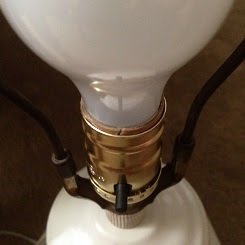
    Step 3: Fig.5 shows this old damaged brass lamp socket comes with a decorative key to turn the lamp on or off. The decorative white plastic below the lamp socket will be removed and not reused.
    Fig.5 Brass lamp socket
    Step 4: Fig.6 shows the lamp socket seal needed to be cut to remove the top part of the socket. The brass arms coming on the sides are the harp base that is attached to the neck of the lamp. Fig.7 shows that the lamp socket was pulled from the lamp showing an inner cardboard sleeve.
    Fig.6 Lamp socket seal
    Fig.7 Lamp socket 
    has two layers
    Step 5: Fig.8 and fig.9 shows that once the exterior brass covering has been removed, the electrical wire has been attached by two screws. Using a flat head screwdriver turn counterclockwise to unscrew the metal screws releasing the electrical wires.  

    Note: As a safety measure the electrical cable has a knot to prevent the electrical cord from being pulled out of the lamp socket.
    Fig.8 Electrical Leads
    Fig.9 Wire knot
    Step 6: Fig.10 shows that underneath the lamp socket is a wire knot needed to be removed to get the wires out of the lamp. Fig.11 shows the old lamp socket ready for the trash can.
    Fig.10 Remove wires
    Fig.11 Internal lamp socket
    Step 7: Fig.12 shows the twisted electrical cord still inside the lamp.
    Fig.12 Twisted cord
    Step 8: Fig.13 shows remove the electrical leads. Remove the lamp wire by pulling from the bottom of the lamp. Fig.14 shows the bottom of the lamp, next peel of the cardboard exposing the lamp cord.
    Fig.13 Electrical cord
    Fig.14 Peeling cardboard
    Step 9: Fig.15 shows the bottom of the lamp socket that has an internal threads attached to the lamp neck. Fig.16 shows the lamp post with male threads (external threads). Take apart the lamp neck by unscrewing the brass screw above the white decorative neck.
    Fig.15 lamp neck/harp bottom
    Fig.16 External neck
    Step 10: Fig.17 shows the vase cap with a cork washer and fig.18 shows the porcelain lamp base.
    Fig.17 Vase Cap with 
    cork washer
    Fig.18 Porcelain Lamp Base
    Step 11: Fig.19 shows a side view of the porcelain lamp base.
    Fig.19 Side of lamp

    How to Rewire a Lamp


    Update: DIY Advisor has New blogs check them below today:

    • Cookie Alert: European Union laws requires that you know that this blog uses cookies. If you are concerned about this please click here to see how Google uses this information.


    Note: The DIY Advisor assumes no liability for omissions, errors or the outcome of any jobs. The reader must always exercise reasonable caution, follow current codes and regulations that may apply, and is urged to consult with a licensed contractor if in doubt about any steps on these posts. All names were changed to protect client's privacy. DIY Advisor. Reproduction of site content including photos without permission prohibited. All rights reserved. © Copyright 2011-2015